
Part I: The Bill Nobody Voted For

On February 11, 2026, a National Park Service official logged onto a virtual meeting to discuss something extraordinary: whether the federal government should extend its protective reach over the Santa Monica Bay coastline, preserving it for future generations under the same laws that safeguard Yellowstone and the Grand Canyon.
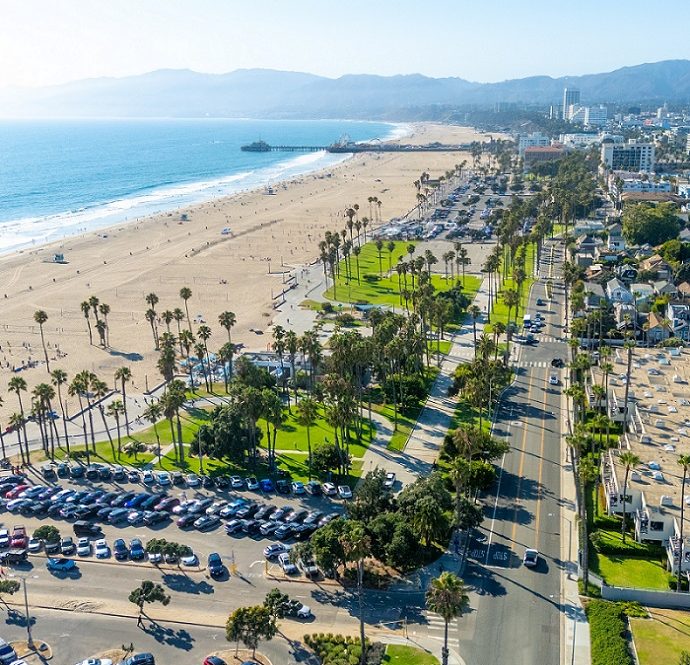
The study area extends along shores where generations of Angelenos have measured their lives—first beach days, sunset walks, the unchanging horizon that anchors a changing city.
One day earlier, on February 10, State Assemblymember Rick Chavez Zbur introduced legislation that would do precisely the opposite—stripping away layers of state oversight that have protected California’s coast for half a century, and handing control to local governments eager to accelerate development.
On that day, residents of Santa Monica discovered that their City is listed with two pro-development sponsors of that bill. These residents also discovered the City Council never voted on sponsorship for the bill.
Interestingly, this isn’t the first time Santa Monica has faced a crossroads over its coastline. The last time the question was asked of voters, they answered decisively—and their answer was opposite to what our City appears to have pursued in Sacramento.
When Voters Had Their Say
In November 1990, our voters were asked point-blank whether they wanted beachfront development. Their response was overwhelming: No.
By a significant margin, voters approved Proposition S, the ‘Save Our Beach’ initiative, prohibiting hotels and large restaurants west of Ocean Avenue. Slow-growth activist Sharon Gilpin, who led the successful campaign, offered a warning that resonates thirty-five years later: ‘People are tired of the City Council doing deals and trotting them out two years later.’
In 1990, voters used the initiative process to firmly reject City Council approvals. In 2026, it appears that 2023’s council priorities may have been invoked to commit Santa Monica to development-friendly state legislation—without any vote whatsoever.
A Tale of Two Futures
Zbur’s Assembly Bill 1740 would allow cities designated as ‘urban multimodal communities’ to bypass California Coastal Commission review for housing projects, transportation changes, and parking modifications. Under the bill, mixed-income housing developments in multifamily zones more than 300 feet from the beach could proceed without Commission oversight, provided they meet the lenient minimal affordability thresholds.
The bill further exempts bike lanes, bus lanes, parking changes, outdoor dining, even ‘short-term and recurring community events’—from Commission review. Local governments are handed unilateral authority over parking policy without any state oversight. Santa Monica happens to meet every qualification the bill establishes.
Meanwhile, the National Park Service study—mandated by Congress—is examining whether the coastline from Will Rogers State Beach to Torrance Beach contains ‘nationally significant resources’ worthy of federal protection. If designated, lands directly managed by the Park Service would be ‘protected in perpetuity.’
We have two levels of government, with two radically different visions, and all for one coastline.
The Sponsorship That Never Was
That day, when residents discovered Santa Monica’s name on AB 1740’s sponsor list, they asked, “When did the City Council approve this?”
Last week, the following responses were explained to participants in Facebook social media exchanges with current Councilmember Lana Fernandez Negrete (CC-LFN) and former Councilmember Oscar de la Torre (FC-ODLT):
CC-LFN provided a striking answer:
‘No, it wasn’t discussed during a City Council meeting or in closed session.’
FC-ODLT explained how this happens:
‘The City Council majority sets the legislative agenda, but City staff also has access to the City’s paid lobbyist.’
(NOTE: Apparently, we pay Sacramento and Washington, D.C. lobbyist salaries)
FC-ODLT elaborated:
‘If Council gives very loose direction, such as “support policies to expand housing,” then that’s all that staff needed to justify their decision to weaken the Coastal Commission.’
CC-LFN acknowledged the opacity:
‘There is a practice to automatically sign onto legislative measures and send support letters or add names to support letters based on it matching up with council priorities. I’ve asked for an update on that policy to be able to share so the public understands how that works. Currently, the priorities listed on the website are old and from 2023.’
Sharon Gilpin’s warning in 1990 has aged into prophecy. If the pattern these accounts suggest holds true, there are deals happening in Sacramento, negotiated by paid lobbyists citing outdated Council priorities, with residents learning about them only after seeing the City’s name attached to the bill.
The Incomplete Framework
Adding complexity to this situation is Santa Monica’s regulatory standing with the Coastal Commission. The City adopted a Local Coastal Program Land Use Plan in 2018, and the Commission certified it. However, Santa Monica does not have a fully certified Local Coastal Program because the Implementation Plan—the component containing zoning and regulatory measures—was never certified.
What this means in practice is that Santa Monica lacks the full LCP Land Use certification, therefore the Coastal Commission retains authority for coastal development permits, since local authority has not been fully delegated.
Handily for developers, AB 1740 would effectively circumvent this careful regulatory framework by granting local approval authority for a wide range of projects. Yet Santa Monica lacks the verified process designed to ensure local regulations will adequately protect coastal resources.
The California Coastal Commission was established in 1972 by voter initiative and became permanent in 1976. This was precisely because Californians recognized how local city governments—facing development pressure and responding to organized interests—were more likely to fail to protect the public’s stake in coastal resources.
Fortunately, what the Commission protects is not merely sand and tideline, but the accumulated meaning of place—the coastal environment as Californians have known it, remembered it, and handed it forward. AB 1740, in effect, treats this inheritance as an obstacle to efficiency.
Now, Santa Monica City, having neglected to complete the legal process available to earn local control, has bypassed public sentiment, listing itself as a sponsor of legislation that would enable them to take that control anyway.
See next week’s article, Part II: The Stakes Along the Shore
Sources:
City of Santa Monica Coastal Zone map (Information Systems Division);
AB 1740 bill text (California Legislative Information);
National Park Service study (parkplanning.nps.gov/LosAngelesCoastal);
Los Angeles Times, November 8, 1990;
Social media sharing between former Councilmember Oscar de la Torre, current Councilmember Lana Fernandez Negrete, and participants during their Facebook exchanges.
Jack Hillbrand, Architect, for SMa.r.t. Santa Monica Architects for a Responsible Tomorrow
Web: www.santamonicaarch.wordpress.com/writing
Mario Fonda-Bonardi AIA, Former Planning Commissioner, Robert H. Taylor AIA, Dan Jansenson, Former Building & Fire-Life Safety Commissioner, Sam Tolkin, Former Planning Commissioner,
Michael Jolly ARE-CRE, Jack Hillbrand AIA, Landmarks Commission Architect, Phil Brock (Mayor, ret.), Matt Hoefler, NCARB, Architect, Heather Thomason, Community Organizer.