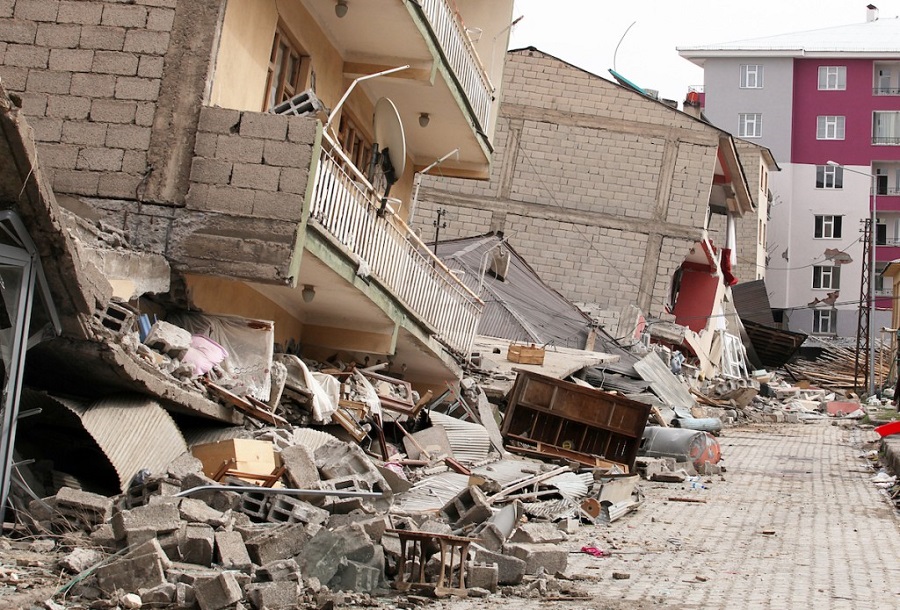

It was 4:31 in the morning when the San Fernando Valley lurched. The Northridge earthquake lasted less than 30 seconds. The effort to reckon with what it revealed would consume the better part of three decades.
For Santa Monica, the disaster delivered a specific, devastating lesson. At the Northridge Meadows apartment complex, 16 residents were killed when the building above their ground-floor units collapsed onto them. What the earthquake exposed was not merely bad luck but bad design, a construction shortcut so common across Southern California that it had long since disappeared into the background of the built environment.
The buildings are everywhere, once you know to look for them: apartment blocks where the ground floor opens into rows of tuck-under parking, the structure above balanced on slender columns with virtually nothing in between. The design solves one of the great logistical puzzles of dense urban living. It also, engineers now understand, creates a catastrophic vulnerability. When the ground shakes, that open first floor has little to resist the swaying mass above it. The whole structure can collapse in on itself — floor by floor, in seconds.
In the immediate aftermath of Northridge, Santa Monica declared an emergency and passed its first post-1994 ordinance. Five years later, in 1999, the city went further, formally mandating retrofits for the most dangerous building types. Then, for nearly two decades, the buildings largely stayed as they were.
What followed was what policy researchers sometimes call an implementation gap — the yawning distance between a law’s intention and its effect. The 1999 mandate had no dedicated enforcement staff, no system for tracking whether owners were complying, no meaningful consequences for those who did not. The ordinance existed on paper. The hazard persisted in concrete and wood. “The failure wasn’t engineering,” one city document later noted. “It was administration.”
Santa Monica finally confronted that failure in 2017, when the City Council adopted a sweeping new program designed to finish what the earlier law had not. The approach was methodical in a way that its predecessor was not. Engineers and city staff identified 1,956 specific buildings through field surveys and archival research. They established a five-step compliance path, from initial review to final inspection. And they assigned real people to manage the process — staff members whose job was to move cases through the system and notice when they stalled.
The program also borrowed a concept from emergency medicine: triage. City officials and structural engineers ranked buildings by the nature of their hazard and the complexity of the fix. Unreinforced masonry, old brick construction with no internal steel, earned the earliest deadlines. So-called tilt-up buildings, whose concrete wall panels can separate from roofing systems in a major quake, were also treated as urgent. Soft-story apartment buildings, the ones with the ground-floor parking, were sorted by size and given a staggered timeline stretching through 2026. Buildings made of non-ductile concrete, a particularly brittle material that was standard before 1977, have until 2027. Steel moment frame structures — whose welded joints famously cracked during Northridge — have until 2037.
Then the pandemic arrived. In 2020, property owners who were already managing shuttered businesses and frozen construction schedules suddenly faced approaching retrofit deadlines. The city’s response illustrated something about the limits of even the most carefully designed policy: the City Council extended deadlines for most soft-story buildings by two years. But it drew a firm line at the structures considered most immediately dangerous. Unreinforced masonry buildings and tilt-ups, where a major earthquake can cause walls to separate from roofs in a matter of moments, received no extension. Their deadlines held. “The city was unwilling to take that risk,” a city summary of the decision noted.
By early 2025, roughly half of the 1,956 buildings on the program’s list had started or completed their retrofits, or had proven that no retrofit was needed. Nearly three-quarters of unreinforced masonry structures were done — a statistic that reflects years of what city staff describe, without drama, as follow-through: administrative citations, escalating fines, referrals to the city attorney, and, when necessary, prosecution. Today, roughly 30% of the buildings originally listed as vulnerable remain in the “active” category: projects in the process of obtaining their permits, or where owners have not yet responded to the notices.
Federal funding can play a role, particularly for larger soft-story buildings. Grants administered through the Federal Emergency Management Agency are available to certain properties, often those with higher occupancy levels, where the projected benefits of retrofit outweigh the costs. Many smaller buildings, however, do not qualify.
None of this produces earthquake-proof buildings. No engineering standard, however exacting, can promise that. What the retrofits are designed to do is narrower and, in its way, more honest: to make it meaningfully less likely that an occupant will be crushed by the floors above them.
Thirty years after Northridge, Santa Monica’s program has become something that its administrators may not have anticipated when they were still sorting out the paperwork: a model. Cities across California and beyond have studied its mechanics, the triage system, the enforcement structure, the financial scaffolding, as they confront the same vulnerabilities that Santa Monica spent two decades pretending it had already addressed.
The lesson, it turns out, extended beyond buildings.
Daniel Jansenson, Architect, for SMa.r.t., Santa Monica Architects for a Responsible Tomorrow
Mario Fonda-Bonardi AIA, Architect and Former Planning Commissioner, Robert H. Taylor AIA, Architect, Dan Jansenson, Architect, Former Building & Fire-Life Safety Commissioner, Sam Tolkin, Architect, Former Planning Commissioner, Michael Jolly ARE-CRE, Jack Hillbrand AIA, Landmarks Commission Architect, Phil Brock (Mayor, ret.), Matt Hoefler, NCARB, Architect, Heather Thomason, Community Organizer, Charles Andrews, journalist, columnist.