
A Comparative Environmental, Financial, and Regulatory Analysis
The Two Scenarios (Three?)
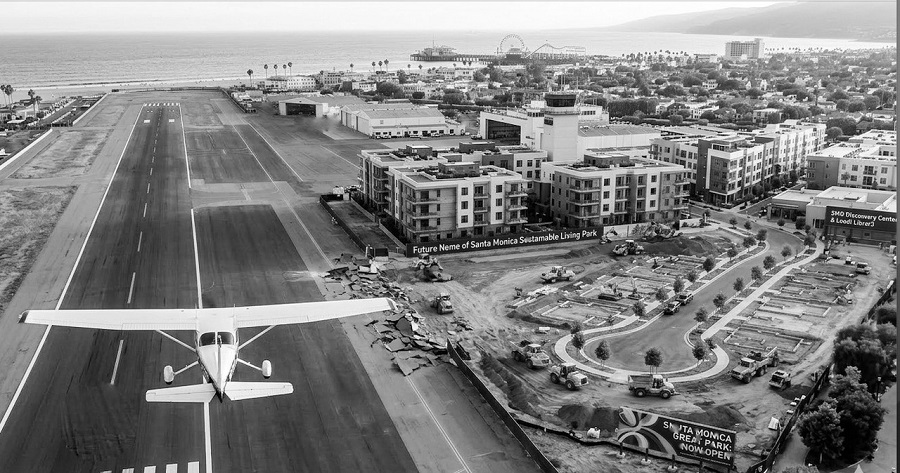
The airport remains operational or closed, but likely leading to the third and future use of the land. So it should be worth taking a look at an analysis of environmental, water infrastructure, financial, and regulatory data to see what keeping the airport operational or closing it is the most environmentally and fiscally defensible option.
Environmental Comparison
The lead and ultrafine particle (UFP) argument — the environmental cornerstone of the closure case — is substantially weaker than publicly presented, and will largely resolve itself independently of any land use decision.
The UCLA Paulson atmospheric study (https:/www.smithsonianmag.com/air-space-magazine/can airport-besaved-180952758/), the primary research cited by closure advocates, found no detectable airport signature on the north, south, or west sides of SMO. The measurable impact was directionally to the east, is periodic, and driven by the prevailing westerly onshore flow. Critically, that research was conducted at approximately 83,000 annual operations. SMO now operates at roughly 57,400 annual operations — a 31% decline from the study baseline, and more than 70% below the airport’s operational peak.
The lead issue is further resolved by federal and California law. The FAA has mandated the elimination of leaded avgas nationwide by 2030, and California’s SB 1193 sets a 2031 deadline. The FAA has already approved unleaded Swift Fuels and GAMI’S G100UL in September 2024, covering the dominant propeller-driven and training aircraft at SMO. The primary environmental argument for closure will have resolved itself before any development on the site could realistically occur.
Financial Reality
The City just released its “Santa Monica Airport Conversion Project” report, in which, listed as its Guiding Principles, a section titled “Balance Economics” states: “The project capital costs should be linked to a reliable funding source(s).” It goes on to state, “Financial responsibility for the project to be defined as the composite of revenue-generating activities, capital strategies, and funding allocations required to avoid an unfunded liability for the City government, shall be adhered to.” But there are no funding sources identified. Developers? Cloverfield Commons? The airport, meanwhile, generates about $20mil/yr with operating expenses of about $6.5mil/yr.
Is the 3,000-unit affordable-only Cloverfield Commons proposal financially coherent as being proposed? At a construction cost of approximately $850,000 per unit, total construction costs reach $2 billion+. Even with City-owned land contributed at zero cost, the financing gap for purely affordable units at the proposed income mix is $450–750 million. Closing that gap requires 1,800– 5,000 market-rate units generating $150,000–$250,000 of cross-subsidy capacity per unit.
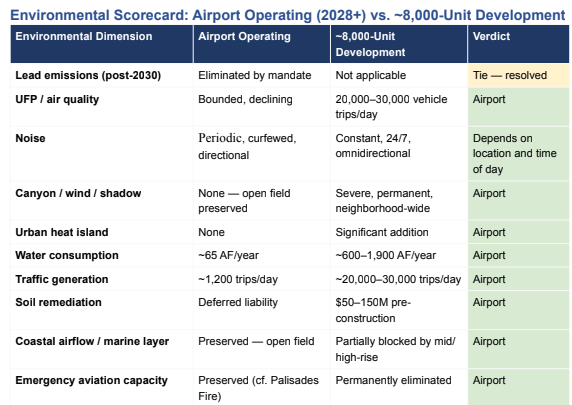
The 5,000–8,000 unit scenario is the most financially coherent of the closure options discussed. Note that to fit 3000 to 8000 units on site has an additional ‘cost’ of Canyon Effect, Wind, Shadows, and Traffic, and up to +/-120 of the 192 acres. Heights of 6-20 stories are required, creating an “Urban Canyon” effect, elevating local temperatures by 2-4°C, and blocking coastal airflow significantly. Shadows from 15-20 story towers would permanently alter the solar environment of Sunset Park. The airport generates periodic, directional, curfewed noise – it’s closed through the night, and only about 1200 vehicle trips per day. An 8,000-unit project generates 20,000-30,000 daily vehicle trips, creating a 24 hr/day noise and traffic crisis on Ocean Park Boulevard, 23rd St, and throughout Sunset Park.
Water Infrastructure
Santa Monica has spent over $200 million and more than a decade restoring local water self-sufficiency, reaching approximately 75% local / 25% imported supply by late 2025, up from a near-complete MWD dependency following the 1996 Charnock well contamination. The city’s remaining capacity gap between maximum local production and current demand — is approximately 1,800 acre-feet per year.
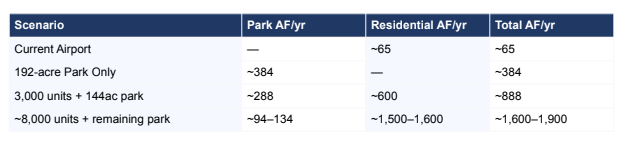
The 8,000-unit development scenario consumes essentially the entirety of the city’s remaining self-sufficiency headroom, directly undermining the $200+ million infrastructure investment made to achieve it. Even the park-only scenario represents a 6x increase in site water demand, with zero revenue to fund it or the supply expansion would require.
Regulatory Framework: SLA, SB 330, and Measure LC
The California Surplus Land Act does not, as written, self-execute. The trigger is disposition on any sale or lease for non-agency use. If the City closes the airport and formally designates the entire 192 acres for use as a park and makes no qualifying disposition, the SLA is not automatically triggered, though no guarantee the State can’t impose anyway during the declared Housing Crisis.
And, the moment the City attempts to generate revenue through any long-term lease — including an educational use arrangement, e.g., with Santa Monica College, which is permitted under Measure LC without a public vote — a qualifying disposition occurs and SLA attaches to that parcel. Once SLA procedures apply, HCD notification and priority negotiation with affordable housing developers is mandatory, with penalties of 30% of fair market value for non-compliance. The only guaranteed protection of the land from the SLA is by maintaining SMO operational.
SB 330 compounds this exposure. It prohibits downzoning below January 1, 2018 intensity levels, caps public hearings on compliant housing applications at five, and makes retroactive ‘Parks Only’ zoning legally vulnerable once a developer files a preliminary application on unzoned land. The Measure LC educational use exemption — undefined, with no statutory parameters on scale or intensity — is a genuine loophole exploitable by a four-vote Council majority, but any lease arrangement emerging from it likely triggers SLA regardless of how the use is locally characterized.
Conclusion
The environmental case for closure was always strongest when lead was the primary argument. That argument dissolves on its own regulatory timeline — independently of anything the City Council decides. Against that residual and diminishing liability, the development alternative substitutes permanent, irreversible, 360-degree urban infrastructure impacts — traffic, canyon effect, shadow, heat island, water stress — affecting a far larger number of existing residents with no mitigating technological transition on the horizon.
Keeping SMO operational is, across environmental, water infrastructure, and financial dimensions, the most defensible position available to the City, and the only guaranteed protection against implementation of the SLA. The case for closure has always rested on noise and environmental arguments. As the lead issue resolves itself by federal mandate and the financial and infrastructure costs of the development alternative come into sharper focus, those closure arguments fail.
Bob Taylor, AlA
for SMa.r.t.
Santa Monica Architects for a Responsible Tomorrow
Dan Jansenson, Architect, (ex-Building & Fire-Life Safety Commissioner); Robert H.Taylor, Architect AlA; Thane Roberts, Architect; Mario Fonda-Bonardi, Architect AlA (ex-Planning Commissioner); Sam Tolkin, Architect, (ex-Planning Commissioner); MichaelJolly ARE-CRE; Jack Hillbrand AlA, Landmarks Commissioner Architect; Matt Hoefler, Architect NCARB; Charles Andrews, Journalist/Columnist
For previous articles, see www.santamonicaarcn.wordoress.com/wruno
We addressed water specifically last week (https://smmirror.com/2026/03/sm-a-r-tcolumn-have housing-mandates-ignored-state-water-shortages/) and will address environmental and cost issues more in depth in future weeks.