
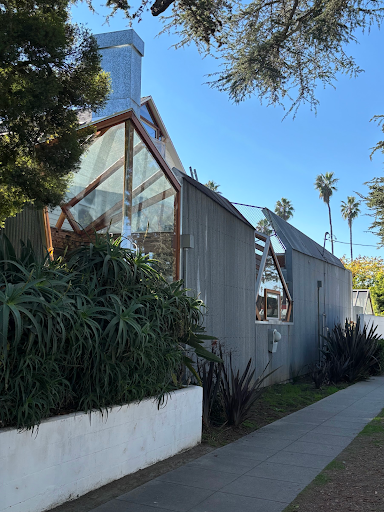

Last Friday (December 5), we lost one of our own: Frank Gehr,y who passed away at age 96, is probably the most recognized American architect. His storied local, national, and international career started and blossomed right here in our own small town of Santa Monica. An architect with that International reach could have located his practice and residence anywhere in the world, but he chose to do so right here in Santa Monica.
Born in Canada, he started his career designing cardboard living room furniture, which foreshadowed his long fascination with using humble materials in unusual ways. He progressed from using asphalt in his kitchen floor to chainlink fence on his personal residence and Santa Monica Place to galvanized steel (Edgemar) and then to his distinctive stainless steel (Bilbao) found on many of his later works (Disney Hall).
But the real evolution of his style was making buildings that became more and more sculptural. His design evolution was made possible by the progress in computer-aided design, which allowed the design and construction of the sinuous curves that made his buildings so interesting and pleasing. His design direction was really facilitated when he started using computer programs originally used for designing airplanes, that allowed him to create large, complex forms that would be virtually impossible to design by hand.
He was not only an early adopter of 3D computer design tools he was also known for making an exceptional number of excellent cardboard, wood, and plastic models for each project. For larger commissions, he might make several models of increasing complexity as the project progressed and the design inevitably changed. These models were not only useful for wowing clients, public officials, and reviewing Commissions, but when lined up end to end, became a perfect record of his design process and of the path taken to the final product we actually inhabit.
There is currently no Frank Gehry museum. However, his final Santa Monica project, as yet unbuilt, is the sophisticated skyscraper hotel/condo and apartment project proposed for the north side of Santa Monica Boulevard and Ocean Avenue. That complex project, which involves a rooftop viewing deck open to the public and the relocation of two historic buildings, also involves a new public museum that may become the repository of his models and exhibits. That project that has been years in the making is Gehry’s last wave to the City he loved and loved him.
Gehry’s gift to us is he freed us from the “box”. For example, Disney Hall, whose sumptuous main space is perfectly symmetrical for acoustic reasons, is wrapped in an explosion of shapes that completely hide its otherwise boring symmetry. He treated buildings as sculpture so they met all the functional, safety, and programmatic requirements, but also being pleasing and exciting both to their inhabitants and their spectators. Just looking at pictures of his Louis Vuitton building in Paris makes you want to go there.
Coincidentally, 2025 has not been a good year for Santa Monica architects. In August this year, Louis Naidorf, who designed our own landmarked fabulous Civic Auditorium, passed away also at the age of 96. Gehry’s buildings, which are numerous all over our City and region, were mostly built in the last 50 years, so they will start coming up as candidates for landmarking. Fifty years is the usual time needed to establish historical significance. Landmarking cannot happen soon enough for his buildings because buildings are always changing, sometimes to the detriment of their historically defining features. Gehry’s Santa Monica Place shopping center has already had a massive facelift, diverging from his original concept.
As we say goodbye to Frank Gehry, we’re not just mourning a legendary architect. We’re remembering a neighbor whose wild imagination helped shape the look and spirit of our region.
He taught us that architecture can be fearless, joyful, and thus deeply human. And for that, Santa Monica, S.M.a.r.t. (Santa Monica Architects for a Responsible Tomorrow) and lovers of architecture, will always be grateful.
By Mario Fonda-Bonardi AIA
Santa Monica Architects for a Responsible Tomorrow
Dan Jansenson, Architect, (former Building & Fire-Life Safety Commissioner); Robert H. Taylor, Architect AIA; Thane Roberts, Architect; Mario Fonda-Bonardi, Architect AIA (former Planning Commissioner); Sam Tolkin, Architect, (former Planning Commissioner); Michael Jolly ARE-CRE; Jack Hillbrand AIA, Landmarks Commission Architect; Phil Brock (SM Mayor, ret.); MattHoefler, Architect NCARB; Heather Thomason, community organizer.


