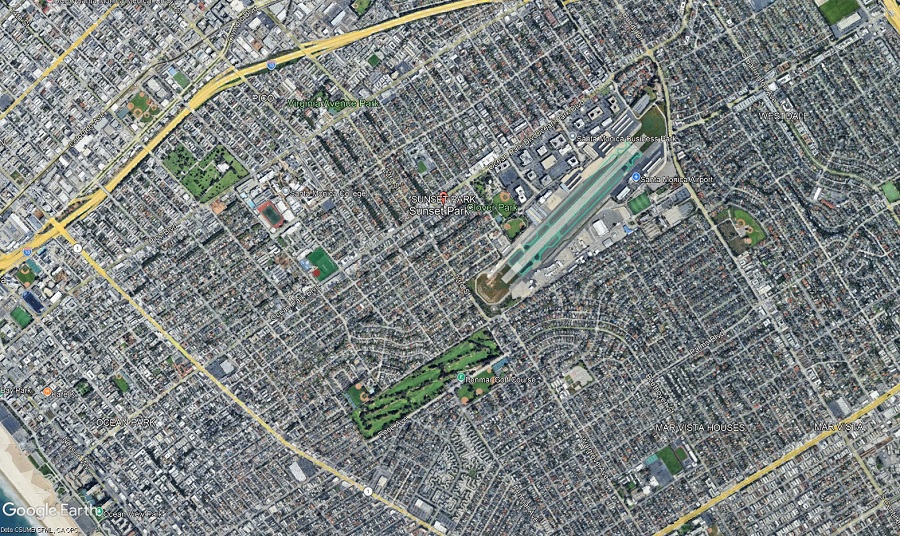

If you live in Sunset Park, Pico Neighborhood, or several other Santa Monica neighborhoods, a process is quietly underway that could permanently reshape where you live. It’s framed as a study. But the more you look at it, the more it looks like something else.
The Santa Monica Planning Commission is being asked to scope an “affordability study” for single-family neighborhoods – who could object to studying affordability? But before anyone agrees, it’s worth asking: What, exactly, are we studying, and why?
Because a state law already addressed this last July SB 1123 allows a lot of a single-family home to be divided into as many as 10 lots (depending on the size of the original lot). Your neighbor’s lot can now become several starter homes or townhomes – up to 1,750 square feet each, plenty of room for three bedrooms and a family (the home I grew up in, for example, was 1377 sq ft and had 3 bedrooms). The City Attorney has confirmed that Santa Monica can adopt it as written, with no additional study or expanded zoning. Nothing further is required.
Let’s be honest about what’s happened here. Sacramento passed yet another law taking away cities’ control over their own planning – adding market-rate housing that doesn’t solve our affordability problems. And a few members of our City Council looked at that and said: Not enough. We want to go further.
SB 1123 is already a significant change. And many of us can live with it under our current development standards. We may not love that Sacramento imposed it, but the law is intended to produce reasonably scaled homes in our neighborhoods. What’s been angled for since last July by a few Council members – 3-story heights, 50% more building mass, reduced setbacks – is something else entirely, designed to incentivize the erasure of these neighborhoods as we know them. There’s value in a city having neighborhoods that look and feel different from one another – and low-density areas are part of that variety, not a problem to be solved.
So what exactly was this study for when the Council voted to put it in motion? Is the goal deed-restricted affordable units? Market-rate starter homes – which the law, as written, already makes possible? The Council’s own direction, as shown on the agenda slides, trails off into ellipses. That’s not a research question. That’s a blank check.
The pattern is hard to miss. The Council members driving this process have made no secret of where they want to end up – 3-story heights and 50% more building mass are what they pushed through in last summer’s “emergency” ordinance, bypassing the Planning Commission entirely, and what they directed the Commission to recommend last November. Some have signaled they want to go even further. Now there’s a study. The destination hasn’t changed; just the route.
The data being used to frame this discussion follows the same pattern. Planning staff is working within the direction they’ve been given, and it’s easy to see how framing can reflect the priorities of those giving the orders in the first place – but it’s still worth scrutinizing. The “Housing Costs” slide cites a citywide single-family median of nearly $4 million, but the neighborhoods this study would most likely reshape have a median closer to $1.8 million – still expensive, but a very different story. And the presentation suggests SB 1123 only applies to vacant lots, when the planning department itself has confirmed that any property without a renter in the last five years can simply be demolished to qualify – which is a lot of the single-family housing stock.
To its credit, this Planning Commission has shown some independence – asking hard questions, doing things thoughtfully rather than rubber-stamping, and pushing back when the directive felt too much like an order. That’s exactly why the framing matters. The Commission is being handed a process set up to point in one direction. The question is whether it will function as an independent inquiry, or whether it’s been designed to arrive at a conclusion reached long ago – because these changes, once made, cannot be undone. Every step in this direction is a one-way door.
And the core promise – that bigger buildings mean more affordable homes – doesn’t hold up. Increasing height and building area doesn’t lower prices; it makes the land underneath more valuable, which makes everything built on it more expensive. Under current zoning, SB 1123 projects naturally produce homes under 1,400 square feet – families live in homes this size and raise kids in them. If the city defines “family housing” so generously that only high-income buyers can afford it, it hasn’t solved a problem – it’s created a more expensive one and called it progress.
And for those who say we have to do something if we care about affordability – we agree. But relaxing zoning in neighborhoods still full of modest homes doesn’t create affordable housing. Market-rate construction alone has never been a reliable path to affordability, and dressing it up as one doesn’t change that.
We support studying housing affordability. Our city needs real answers. But residents deserve to understand what’s happening: a process that began with its conclusion already written is looking for a question to justify it. And the changes being contemplated are permanent.
This Planning Commission has earned the community’s trust by exercising independent judgment. We’re counting on that independence – to demand a real question before commissioning a study, to insist the data tell the whole story, and to recognize when a process has been built to deliver an outcome rather than discover one.
Change isn’t the enemy. Our neighborhoods have always evolved. But there’s a difference between thoughtful evolution and a process quietly engineered to reach a foregone conclusion. Residents deserve to know which one this is – and to keep watching.
*Note: I attended the Planning Commission meeting. In the early part of the meeting, City staff presented the avalanche of state laws that are coming to Santa Monica all at once. SB 79 most transformative among them. When they finally got to SB 1123, it was hard to believe we were really talking about doing even more than the state requires. There were many, many public comments and heated discussion. There was an important observation about how relaxing zoning standards around SB 1123 could end up clashing with Fair Housing goals in the Pico Neighborhood. At least three Commissioners voiced the critical point that this issue of missing middle housing and affordability should not be studied through the lens of SB1123 alone, in a vacuum; a much wider lens, beyond SB 1123 and beyond single family neighborhood, needs to be taken to truly have any clear picture of the best ways for our city to address this issue; we shouldn’t assume the answers are all in single family neighborhoods. Then, in spite of that perspective, they all voted to study, in the words of Commissioner Landres, “what it would take to deliver missing middle housing and affordability through SB 1123.” Still feels like a blank check. And a big advertising campaign to go beyond SB 1123. Stay tuned for what the Planning Department comes up with.
By Heather Thomason, Community Organizer, for SMa.r.t. Santa Monica Architects for a Responsible Tomorrow.
Mario Fonda-Bonardi AIA, Former Planning Commissioner, Robert H. Taylor AIA, Dan Jansenson, Former Building & Fire-Life Safety Commissioner, Sam Tolkin, Former Planning Commissioner, Michael Jolly ARE-CRE, Jack Hillbrand AIA, Landmarks Commission Architect, Phil Brock (Mayor, ret.), Matt Hoefler, NCARB, Architect, Heather Thomason, Community Organizer, Charles Andrews, Journalist, Columnist.