

by Bruce Leddy, SMa.r.t. Guest Columnist
When it comes to new state housing laws that override local zoning, our City Council tends to say, in effect, “There’s nothing we can do! Our hands are tied!” While it’s true most of these laws are immutable – such as SB 1123, SB 9/450, SB 10, and many more – in the case of SB 79, that’s not the whole story.
Some background: For years now, the state of California has taken a “one size fits all” approach to mandating housing development, as if San Francisco is no different than El Segundo or Buttonwillow. In an effort to address the declared housing crisis, these bills override local city planning and zoning with an attitude of, “Build everything, everywhere, all at once!” At best, it is paternalistic (“We’ll tell you how to build your city, little one.”); at worst, it’s a recipe for haphazard development that does little to address the affordability crisis, ignores the massive infrastructure demands it would require, and puts developer profit ahead of thoughtful planning in ways that will negatively impact cities for years.
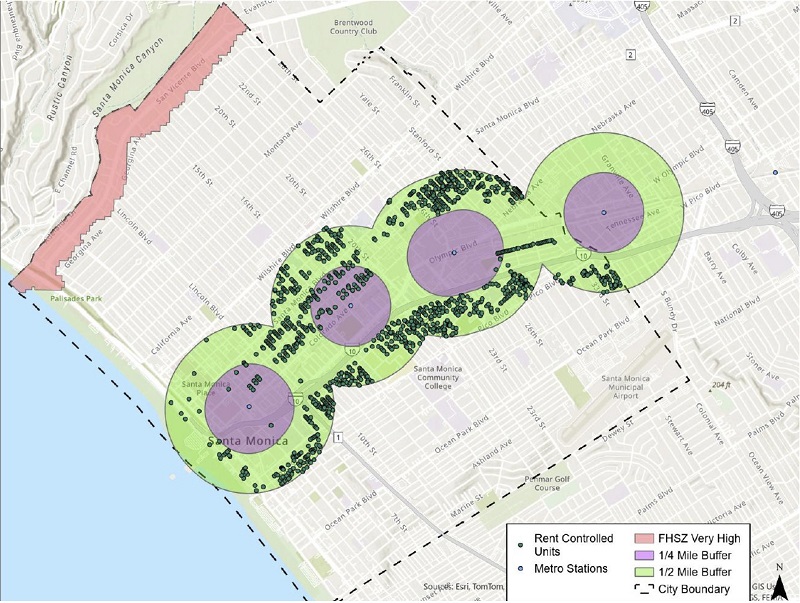
Into this mix comes SB 79, a law ostensibly designed to promote mass transit that, in reality, lets developers build much taller and denser than local zoning allows, anywhere within a half mile of mass transit (referred to as “TOD” – transit-oriented development – zones). Santa Monica’s transit qualifies as “Tier 2,” which means builders can go as high as 85 feet on lots within 200’ of transit stops, six stories within 1/4 mile, and five stories within a 1/2 mile.
Draw a half-mile circle around each metro stop in Santa Monica, and you get a wide swath across the middle of the city, from Wilshire to Pico, disproportionately affecting the Pico and Mid-City neighborhoods. While the law has carve-outs for rent-controlled units, this area has a high proportion of the city’s lower-income residents who would be displaced for years during construction, or permanently if their building is not deed-restricted. [This is why SMRR opposed the bill in their excellent, detailed analysis LINK ]. SB 79 makes no distinction between a residential building and an empty lot; it simply lets developers call the shots. So if a bungalow on a quiet street like Yorkshire Ave is cheaper and will yield higher profit than a commercial lot on Colorado, guess where developers will tear down and build up?
These state housing bills have provided cover for our pro-development City Council when confronted by residents who feel overdevelopment is already hurting the city and may ultimately ruin it if left unchecked. Multi-story complexes looming in single-family areas not only wreck the character and consistency of neighborhoods, it also drives up prices as speculators snap up single-family homes to convert them into expensive apartments, adding to gentrification.
SB 79, however, is different (the tiny ray of sunshine!). One of its key provisions is that a city may submit to HCD (CA’s Housing and Community Development division) their own “TOD alternative plan,” which can take into account many local factors not considered by SB 79, most importantly, what works for the residents and the city as a whole. On March 4th, City Staff presented to the Planning Commission the details of SB 79’s impact in Santa Monica, identifying 2600 potential lots that would likely be subject to its increased density and height limits. But, by creating its own plan, the city can focus additional housing in commercial/mixed-use areas, on unused lots, or on boulevards, and limit the impact on existing residential buildings or single-family neighborhoods. Individual properties can be up to 50% less dense than SB 79 would require, provided the local plan yields the same amount of housing increase overall. In other words, our alternative plan has to create the same number of units, but they can be distributed where our city determines they best fit within the transit zones.
The City of Los Angeles just did exactly that: last week, they approved an SB 79 alternative plan which allows greater density at reasonable heights (mostly four stories) where it makes sense in their city’s transit zones, instead of leaving it to developers to decide to build wherever they can max out profit.
With many of these housing laws, we have no choice but to swallow the state’s bitter remedy and hope for the best (we’re looking at you, SB 1123!). But with SB 79, we have a genuine opportunity to claw back some control of our city’s destiny (and density). On April 15th, the Planning Commission will hold a Study Session to determine if the city should adopt SB 79 as is, or recommend to Council that we create an alternative plan based on what’s best for Santa Monica. While it might seem obvious that we should create our own plan, remember that 6 of the 7 current Council members voted to send the state a letter of support for SB 79 before it was even passed (one of only two cities statewide to do so). Residents need to write in and show up on April 15th to encourage the alternative plan option, so that the increased density we are required to produce is done in a sensible and thoughtful way for our city. There is no time to waste. SB 79 goes into effect on July 1st, and after that, it’s nothing but dark clouds ahead.
Bruce Leddy is the Co-Chair of NOMA and a current Commissioner and former Chair of the Santa Monica Human Services Commission.
Santa Monica Architects for a Responsible Tomorrow
Mario Fonda-Bonardi AIA, Former Planning Commissioner, Robert H. Taylor AIA, Dan Jansenson, Former Building & Fire-Life Safety Commissioner, Sam Tolkin, Former Planning Commissioner, Michael Jolly ARE-CRE, Jack Hillbrand AIA, Landmarks Commission Architect, Phil Brock (Mayor, ret.), Matt Hoefler, NCARB, Architect, Heather Thomason, Community Organizer, Charles Andrews, journalist, columnist.