
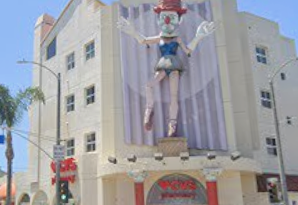
The store at Rose Avenue and Main Street will close in the coming weeks, with prescriptions transferred to a nearby Westside location
By Zach Armstrong
The CVS pharmacy located beneath the towering Ballerina Clown statue will close this summer, staff confirmed to Mirror Media Group.
The retail pharmacy informed customers that the store, located at the intersection of Rose Avenue and Main Street, will close on July 1 and transfer prescription records to a nearby Westside location at 119 S. Lincoln Boulevard.
A store manager declined to comment on the reasons behind the closure but said the pharmacy “has nothing to do with the statue.” The artwork, along with the CVS location, is part of the Venice Renaissance mixed-use property. An agent with Par Commercial Brokerage, which manages commercial properties on the ground level, was not immediately available for comment.
The 30-foot-tall Ballerina Clown, also known as Clownerina, with an uncanny design that combines male and female elements, is one of Venice, California’s most recognizable works of public art. The head is that of a tearful male clown with a five o’clock shadow, a red ball on its nose and a curvy red hat. The body is that of a woman. Oversized white gloves don its hands, a blue dress and white tutu clothe its torso, while red ballet slippers adorn its exposed legs. A motor in its right knee once enabled it to perpetually perform a slow-motion dance number until tenant complaints were enough to pull that plug.
Jonathan Borofsky — the artist behind Ballerina Clown — originally exhibited the piece at MOCA, where it sang a melancholy rendition of Frank Sinatra’s “My Way.” In 1989, developer Harlan Lee commissioned the piece for Venice Renaissance, having been inspired by the circus clowns he saw as a child growing up in Venice. Upon its public installation at the mixed-use development, a Los Angeles Times art critic compared it to pieces by Picasso and Seurat.
“The Venice Boardwalk is full of all kinds of people in all sorts of outfits and the atmosphere is very festive with many live street performances taking place, especially on weekends,” Borofsky once said of how the artwork suits the neighborhood. “Not only does this image bring the male and female together into one figure, but also, two opposite types of performers are represented … if you have ever walked the Venice Boardwalk on a Sunday afternoon, you might understand why this figure is right at home.”


