
Santa Monica officially reports numerous new business openings, often highlighted by the media as signs of economic recovery. However, a walk through the streets tells a different story; it appears less like a revival and more like a replacement. While the influx of new businesses is positive, the key concern is understanding and identifying who can afford to relocate, maintain, or start a business here, and who cannot, for various reasons.
In recent years, Santa Monica’s commercial real estate market has experienced sustained low absorption, indicating limited filling of the growing number of vacant spaces. Although there have been occasional positive upticks in leasing after the pandemic, vacancy levels in key areas such as Downtown, the Promenade, and other major corridors persistently stay high, hovering around 30%, well above historical averages.
That matters more than headlines or political spin because absorption is a direct measure of commercial health. Right now, Santa Monica’s numbers show a market that is still fragile, uneven, and unambiguously tilted toward those with the deepest pockets.
When retail and business-space absorption is weak, storefronts and buildings can sit empty for months, sometimes years, creating a cycle that reinforces negative perceptions, weakens surrounding business activity, and drags down confidence in commercial districts. Rents may eventually be lowered or heavily discounted through short-term deals, but that alone is rarely enough to offset the real and perceived risks facing independent operators in a high-cost environment with inconsistent foot traffic, visible homelessness, untreated mental illness, open drug use, public safety concerns, and rising fears about crime and disorder.
So who is moving into Santa Monica now?
More often, it’s the tenants who can afford to; corporations, chains, franchises, regional groups, LLC investment-backed concepts, and, increasingly, pop-ups or short-term retail tenants with little long-term investment in Santa Monica’s future. That may help temporarily fill storefronts and improve vacancy statistics, but it does little to rebuild the kind of stable, locally rooted business community that once gave Santa Monica much of its identity and character.
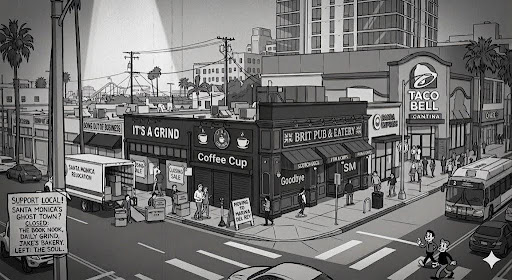
You don’t have to look far to see how it plays out on the ground. Take The Brit Pub & Eatery, a longtime local fixture that gave way to a Taco Bell Cantina, a national brand built for scale, not neighborhood character. Or consider The Misfit Restaurant + Bar, which closed in 2026 after 15 years in the Clock Tower building, reportedly because it chose not to renew its lease. This wasn’t a struggling newcomer; it was a popular, established destination. Its closure underscores a deeper reality: even successful independent operators are finding it harder to justify the economics of staying here. And when Blue Plate Oysterette announced its closure after 16 years on Ocean Avenue, ownership cited a difficult mix of declining foot traffic, rising costs, safety concerns, and the broader challenges facing Santa Monica’s restaurant environment. And when Fresh Corn Grill closed in 2025, the space didn’t remain a one-off independent; it was taken over by HomeState, a growing regional brand. It’s not a global chain, but it’s not a single-location neighborhood shop either.
The trend extends beyond smaller operators. Larger national retailers like REI and Anthropologie (moving in June) have also relocated from Santa Monica to nearby Marina del Rey to access more reliable foot traffic and better operating conditions, such as lower crime rates and improved environmental factors. Doc Martens just left its Promenade location. These moves underscore a broader trend: even well-established brands are carefully assessing whether Santa Monica remains a strategic part of their long-term plans. Nordstrom left and will be relocating to a new Nordstrom Rack in Marina Del Rey, and more businesses followed suit in the exodus, including True Food Kitchen after 14 years, and others drowning in the financial titanic of Santa Monica Place and Downtown. Other Business Districts and corridors are experiencing similar problems, but you get the point.
So, what is really considered “Local” now?
Some newer businesses present themselves as localized neighborhood or family-run operations, and in some cases, they are. But in many cases, they are not. That distinction matters as there is this broader shift happening beneath the surface, one that should concern anyone who values local character and economic independence. Increasingly, businesses that appear local or community-oriented are backed by private equity firms, investment groups, or large multi-unit ownership structures whose primary obligation is to maximize returns.
That doesn’t automatically make them bad businesses, but it does change the incentives.
When investment performance takes precedence, management decisions typically focus on scalability, cost efficiency, and revenue growth, often at the expense of community impact. This approach can lead to higher prices, decreased quality and customer satisfaction, standardized experiences, and business models that favor financial gains over sustainable and unique neighborhood investments.
If Santa Monica wants to preserve the character that makes its commercial districts distinctive, it has to acknowledge a simple reality: Small, family-owned businesses are more than economic units. They are among the most democratic features of American life, giving ordinary people a chance to build something of their own without corporate backing, private equity, or a boardroom full of investors.
Nationally, this trend has played out across restaurants, retail, pharmacies, veterinary clinics, and even housing, where consolidation has often reduced competition and weakened local ownership. Santa Monica is not immune to these pressures, which present a difficult and complex challenge.
Yes, the city is taking well-needed steps to begin addressing this (fee cuts, incentives, activations, including a $3 million economic development fund). This will positively impact the Downtown and Promenade, but much more work remains to be done, and these incentives should be phased into other commercial corridors as well. For example;
- Reduce and simplify all small-business zoning requirements, red tape, processing time, and review fees for all commercial and mixed-use corridors. Large operators can pay attorneys, consultants, architects, and permit expediters; small independents and many property owners often can’t. In this case, the definition of a local small business should be narrowly defined and clearly stated.
- SM City staff need to provide clear, timely, and consistent service. Businesses planning to relocate to Santa Monica, as well as current local enterprises, including architects and contractors, often face conflicting guidance on building codes, zoning, and parking requirements. Staff also need to take a more proactive approach to help the public navigate these challenges smoothly.
Property owners are also impacted and often lack extensive financial resources. Many commercial buildings are owned by small businesses, individual investors, or families who depend on rental income for support or retirement savings. Current economic and environmental challenges can be overwhelming, leading many property owners and businesses to sell their assets.
Current efforts and incentives by the city are a good start, but more wide-ranging and substantive changes are needed, or future opportunities will become reserved primarily for those who can already afford the price of admission, and Santa Monica will lose more of the unique personality that drew people here in the first place.
Michael Jolly
for SMa.r.t.
Santa Monica Architects for a Responsible Tomorrow:
Dan Jansenson, Architect, (ex-Building & Fire-Life Safety Commissioner); Robert H.Taylor, Architect, AIA; Thane Roberts, Architect; Mario Fonda-Bonardi, Architect, AIA (ex-Planning Commissioner); Sam Tolkin, Architect, (ex-Planning Commissioner); Michael Jolly, AIR-CRE; Jack Hillbrand, AIA, Landmarks Commissioner, Architect; Phil Brock (ex-mayor, retired); Matt Hoefler, Architect NCARB; Heather Thomason, Community Organizer; Charles Andrews, Journalist/Columnist; Bruce Leddy, Human Services Commissioner/NOMA Co-Chair