
Santa Monica’s housing debate is no longer just about zoning, density, or state mandates. It has become a test of basic political ethics—and of whether residents can trust how major land-use decisions are being made at City Hall.
At the center of the controversy is a formal ruling by California’s political watchdog, the Fair Political Practices Commission (FPPC). The FPPC ordered City Councilmember Jesse Zwick to completely recuse himself from all housing- and zoning-related matters.
The ruling is unusually strict. Zwick is barred not only from voting, but from participating in discussions, attending closed sessions, or even remaining in the room when housing items are considered. Before leaving the chamber, he must publicly state the source of his conflict of interest.
The reason is straightforward. Zwick holds a paid position with the Housing Action Coalition (HAC), a pro-housing advocacy organization whose mission, funding, and legislative goals are directly tied to increasing housing production and changing zoning rules. The FPPC concluded that City Council decisions on housing could materially affect Zwick’s employer—and therefore his income. Under California law, that alone is enough to disqualify him.
This ruling did not come out of nowhere.
For months, neighborhood groups and civic organizations had raised concerns about conflicts of interest, private communications, and a pattern of rushing major zoning changes through with limited public scrutiny. Public records reportedly show Zwick engaging in private, behind-the-scenes communications, known as ex parte communications, with housing providers and developer executives while public hearings were still underway. These conversations were not shared with residents speaking at the meetings.
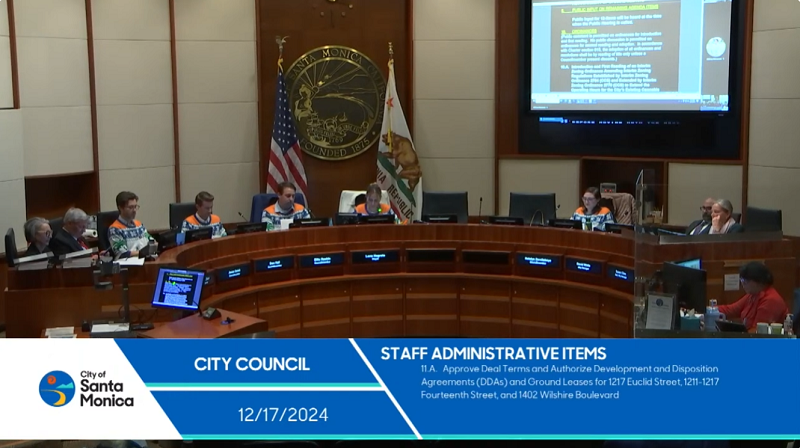
One such exchange allegedly occurred during a December 17, 2024 City Council meeting—while public comment was still ongoing.
The fallout has been immediate. Santa Monica has been forced to begin ratification proceedings, meaning the city must re-vote on multiple housing-related decisions that were approved while Zwick was either employed by HAC or negotiating for that role. These include votes on local density increases, duplex regulations, and small-lot subdivisions.
Many residents argue this isn’t enough. If conflicted participation shaped the outcome, they say, the city should void those decisions altogether—not simply re-vote and move on.
That demand grows sharper when the substance of the policies is examined.
State law SB 1123 already represents a major change to single-family zoning. It allows single-family lots to be split into parcels as small as 1,200 square feet, potentially accommodating up to five starter homes. Santa Monica was required to implement this law, but it was not required to go further.
City Council did not push back on SB 1123 before it became state law—it proposed adding its own local zoning changes on top of SB 1123. These additions would significantly increase density in single-family neighborhoods such as Sunset Park, Pico, NOMA, Ocean Park and the Northeast. The proposals included allowing three-story buildings, increasing allowable building size by 50 percent, and reducing setback requirements.
In fact, the resulting density would exceed what is currently allowed in some zones slated for multifamily housing.
Supporters framed these changes as necessary to support families and affordability. Councilmember Dan Hall argued that three-story buildings might be needed to accommodate three-bedroom units. Councilmember Natalya Zernitskaya and others described the proposals as being “in the name of families.”
Putting it politely, critics aren’t buying it. Larger buildings and more square footage don’t automatically produce affordability—especially in one of the most expensive housing markets in California. What they do reliably produce is higher project value and higher returns.
According to multiple accounts, the specific terms of the proposal—three stories and a 50 percent increase in allowable building area—did not originate from a city planning analysis. Instead, they reportedly came from a developer’s email to Councilmember Zwick. To opponents, this looks less like thoughtful housing policy and more like developer-driven rezoning wrapped in political “happy” language.
How the Council tried to pass these changes only deepened public mistrust.
The Council initially attempted to adopt the SB 1123 implementing ordinance as an “emergency” measure. Declaring the existence of a “current and immediate threat to public health, safety, and welfare,” allowed it to take effect immediately—bypassing normal safeguards such as Planning Commission review, extended public notice, and meaningful community input.
Residents described the process as rushed and opaque. The claim of urgency, they argue, was questionable—especially since the ordinance went far beyond what state law required.
The emergency designation didn’t hold up. Legal challenges followed. The Council ultimately rescinded the ordinance, effectively ending the lawsuit. But rather than abandoning the expanded density proposals, the city shifted to “studying” the same changes through other legislative paths. Exactly how City Council intends to revisit these issues while conveniently overlooking Mr. Zwick’s earlier, ethically questionable remarks remains unclear..
All of this has fueled a broader public outcry. Why, residents ask, is the Council pushing local density increases that exceed sweeping state mandates? Why were these changes rushed through under dubious claims of urgency? And why do so many of the policy details align so neatly with developer wish lists?
This is no longer just a policy disagreement. It is a credibility problem.
Housing reform is difficult and controversial by nature. But it cannot be credibly debated when conflicts of interest, private communications, and procedural shortcuts shape the outcome. Santa Monica now faces a clear choice: treat this episode as a technical compliance issue—patched up with recusals and re-votes—or recognize it as a warning sign about how power is being exercised at City Hall.
Transparency and accountability are not obstacles to housing policy. They are prerequisites.
The implications for the upcoming election are clear. Voters will be asked a fundamental question: Should Santa Monica’s future be shaped through transparent, accountable governance—or through insider-driven processes that treat public participation as a formality?
This November, housing policy will be on the ballot. But as this episode makes clear, trust may be the issue that ultimately decides the race.
Daniel Jansenson, Architect, for SMa.r.t. Santa Monica Architects for a Responsible Tomorrow.
Mario Fonda-Bonardi, AIA, former Planning Commissioner, Robert H. Taylor, AIA, Architect. Dan Jansenson, Architect, former Building and Life Safety Commissioner. Samuel Tolkin, Architect, former Planning Commissioner, Michael Jolly, AIR-CRE. Jack Hillbrand AIA, Landmarks Commission Architect, Phil Brock, former SM Mayor (Ret.), Matt Hoefler, architect, Heather Thomason. Community Organizer.