
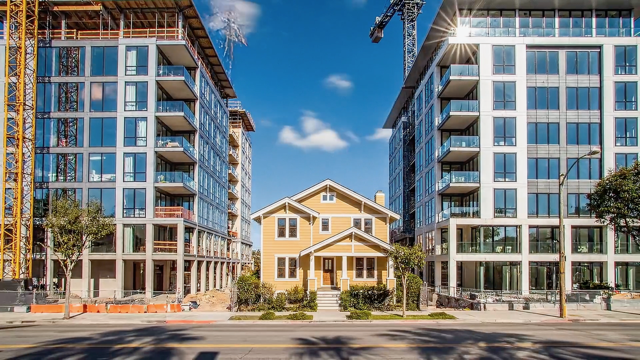
Walk down Ocean Park Boulevard, and you can feel something coming. Development signs announce seven- and eight-story buildings that will tower over local shops and restaurants. Almost 1,000 mostly luxury units. Across Santa Monica, neighbors who love their “Neighborhood Commercial” streets are wondering: Could this be coming to my neighborhood? To Main Street? Pico? Montana Avenue?
If you aren’t, you should be. Because it can. And it is. A quick check of the City’s development projects shows multiple 8-story buildings across the city, an 11-story on Broadway, and even a 23-story on 7th Street. 23 stories! So much for ’nothing taller than the clock tower.’
How did we get here, and more importantly, what can be done before it’s too late? It’s a long and winding road, but if we want a say in any of this, we need to understand the details.
It is tempting and easy to frame this issue as a NIMBY vs YIMBY question. Some of the key participants are counting on the public to do so. But that framing is inaccurate and polarizing. California’s housing affordability crisis is real. Most people are open to new development if it’s thoughtful, respects neighborhood scale, and (most importantly) produces truly affordable housing. Understanding what’s actually happening in Santa Monica requires knowing the data, the history, and the politics.
So let’s get into the weeds. Together.
THE FOUR-LETTER WORD YOU’VE NEVER HEARD: RHNA
Every eight years, California’s Dept of Housing and Community Development (“HCD”) tells each region how many new housing units it must plan for in the next eight years. The regional authority (in our case, the Southern California Association of Governments, or “SCAG”) then mandates how many units each city must plan for. Not build. Plan for.
This process is called the Regional Housing Needs Allocation, or RHNA (pronounced “Ree-nah”).
Our RHNA number in 2012 (the previous cycle) was 1,674. Then in 2021, Santa Monica was suddenly allocated 8,895 units.
It’s hard to convey how massive that number is. Santa Monica’s existing housing stock is roughly 53,000 units, built over more than a century. The state asked us to plan for the equivalent of one-sixth of our entire housing stock in eight years. In a city that is 8.3 square miles and essentially built out. And the real number is bigger still: a huge share of those units, nearly 6,200, must be “deed-restricted affordable” (housing units legally required by deed to be rented or sold below market to income-qualified households). Because developers typically build only one affordable unit for every six market-rate ones, hitting our 6,200 affordable target would require roughly 37,000 total units. Let that sink in.
The day the numbers dropped, veterans of multiple RHNA cycles thought 8,895 was a joke. Sadly, it wasn’t. How did we arrive there?
A NEW RHNA METHODOLOGY FROM MONEYED LOBBYISTS
In 2018, a new law authored by State Senator Scott Wiener changed the rules of how RHNA numbers would be allocated. HCD was now required to factor in what the state characterized as decades of underbuilding, a sweeping reframe that dramatically inflated the numbers. The final number of units for Southern California to absorb: 1.34 million. More than triple the previous cycle. Wiener’s 2020 reelection campaign was roughly 30% funded by the real estate lobby, according to Capitol Weekly.
Given the new numbers, you might expect Santa Monica’s share would roughly triple from last cycle’s allocation. Ours went far beyond triple. From 1,674 to 8,895. How did this happen?
SCAG used to rely on each city’s own growth projections. Cities knew their land, their infrastructure, their capacity. This time, as SCAG developed its distribution methodology under the new state rules, lobbying organizations like Abundant Housing LA – a self-described YIMBY group that does not disclose all of its funding sources – got a seat at the table, with representatives participating directly in methodology discussions. The group pushed for an allocation based on a new formula. Under it, communities with acres of vacant land got proportionally lower RHNA allocations. Cities with proximity to jobs and transit got more.
Santa Monica – with the Expo Line, a large employment base, and, perhaps not coincidentally, some of the most valuable land in California to develop – bore a dramatically outsized share.
This goes far beyond “shared responsibility.”
THE CITY MAKES A “HOUSING ELEMENT”
After everyone’s jaws dropped at that impossible assignment of 8,895 new units in eight years, Santa Monica got to work. State law requires cities to make a plan (called the Housing Element) that shows how zoning will be changed to accommodate the assigned RHNA numbers. Santa Monica designed its Housing Element around the 8,895 number, but in early 2022, HCD rejected it. Organizations like Abundant Housing LA were actively monitoring cities’ Housing Elements and pressuring HCD to reject plans they considered insufficient – a role Scott Wiener’s law had essentially empowered them to play. Even though the city had shown capacity for the full 8,895, HCD insisted it needed even more. A “buffer” in case some sites turned out to be harder to develop. 4,000 more units.
Where, in a desperate pinch, do you find capacity for that kind of density in a city that’s already built out? Enter our Neighborhood Commercial streets: previously zoned for two- and three-story buildings, and never designed to absorb massive growth.
Ocean Park Boulevard. Montana. Pico. Main. All suddenly bumped to 55 feet. If only that were the end.
THEN NEW STATE DENSITY BONUSES STACK ON TOP
Over the next few years, Sacramento passed a series of ‘density bonus’ laws.
In exchange for a handful of deed-restricted affordable units, developers could build well beyond the new zoning. Streets capped at 55 feet were suddenly cleared for 85 (possibly even 110). Even though Santa Monica’s plan for taking on unprecedented density had been approved, the legislature said: even more.
Two stories on Neighborhood Commercial became seven to eight (or more).
And with that, we aren’t just losing our skyline. We’re losing the chance to build actual low-income housing. The density bonus law gives developers far more than it asks in return – and the handful of affordable units they produce barely dents the crisis the State says justifies it.
WHAT YOU CAN DO: ADVOCATE FOR BETTER METHODOLOGY
While Abundant Housing was invited to the table for the last RHNA cycle, the rest of us didn’t even know there was a table. 18 million people were affected by the last methodology process. Only 250 public comments were submitted.
The 7th cycle methodology development is already underway. YIMBY California and YIMBY Law are already at the table, listed as official participants. Abundant Housing LA will no doubt be there soon if they aren’t already. Residents and neighborhood organizations who want thoughtful development must claim seats, too. Sign up to be notified about SCAG hearings and show up or send in comments. Email our SCAG representative on Council, Ellis Raskin (Ellis.Raskin@santamonica.gov). Ask him to fight for a methodology that accounts for all the state laws that have upzoned so much of our city in the last four years and already added tremendous housing capacity (SB79 alone, passed just last year, opened the door to over 200,000 units, per our Planning Department’s figures). Ask him to demand our RHNA account for realistic funding availability for directly building deed-restricted affordable units, or that the State fund its own mandate. Ask him for a methodology that accounts for our active earthquake fault lines, fire hazard zones, and sensitive coastal environment here that warrant reduced density.
Or eight-story buildings on Ocean Park Blvd, Montana, Pico, and Main will only be the beginning.
Get into the weeds. Before the next cycle is decided without us.
Heather Thomason for SMa.r.t.: Santa Monica Architects for a Responsible Tomorrow:
Dan Jansenson, Architect, (ex-Building & Fire-Life Safety Commissioner); Robert H.Taylor, Architect, AIA; Thane Roberts, Architect; Mario Fonda-Bonardi, Architect, AIA (ex-Planning Commissioner)Sam Tolkin, Architect, (ex-Planning Commissioner) Michael Jolly ARE-CRE; Jack Hillbrand, AIA, Landmarks Commissioner, Architect; Phil Brock (ex-mayor, retired); Matt Hoefler, Architect NCARB; Heather Thomason, Community Organizer: Charles Andrews, Journalist/Columnist: Bruce Leddy, Human Services Commissioner/NOMA Co-Chair


