
Key Takeaways
- Wi-Fi 7 is less about headline speed and more about stable timing.
- Multi-Link Operation helps devices avoid weak or crowded wireless paths.
- Live games benefit from lower latency, smoother packet flow, and fewer pauses.
- Wi-Fi 7 adoption is growing fast, but full benefits need compatible devices.
In 2024, Wi-Fi Alliance launched Wi-Fi CERTIFIED 7, and it projected more than 233 million Wi-Fi 7 devices would enter the market in 2024, rising to 2.1 billion by 2028. The same launch placed Multi-Link Operation, 320 MHz channels, and 4K QAM at the center of the standard’s practical value. In plain terms, Wi-Fi 7 is being built for homes, offices, games, video, cloud work, and mobile devices that do not just need speed, but also steady timing.
So the question is practical: does simultaneous channel use really change connectivity? The answer is yes, but not always in the way marketing suggests. The clearest gain is not a speed-test number, as it used to be. It is a steadier connection when timing matters.
Live gaming shows why steady links matter
Online gaming now works more like a live activity. It is not just about opening a page or pressing one button. Modern games keep sending information back and forth between:
- your device,
- your Wi-Fi router,
- and the game’s servers.
It was not a surprise when poker tournaments became some of the most participated events in digital entertainment, attracting more people with immersive experiences. A table has clocks, seat changes, chip counts, player actions, hand histories, and real-time prompts. The need for users is different than in offline settings: small packets must move with little delay, and the local wireless connection should not add pauses. This is why a person who wants to play poker tournaments and competitions online may care more about stable latency than raw download speed.
Travel makes that need more visible when in places far from home, the user often cannot control the wider internet path. But the local Wi-Fi hop can still be improved. Thick walls, nearby rooms, shared access points, and mixed devices can all affect how smooth the session feels.
Why is this critical for online poker and similar digital games? Gambling, like many internet activities, often comes with location restrictions. Some casino sites operate in one continent or even one country, but not everywhere else. So, if a player travels and has a scheduled poker tournament, they may use a VPN to browse from their original location. And what does a VPN do? It can slow down the connection, which may be the worst thing during live events. That is why a superior connection is more than important.
Why the local Wi-Fi link becomes the practical upgrade
This does not mean every Wi-Fi 7 router will make every tournament feel perfect. The device, access point, broadband line, and server path all matter. Still, the local link is often the part users can upgrade. For live gaming, that is meaningful. Wi-Fi 7 changes the local network from a single best-effort path into a more flexible system. The result is less focus on the connection and more focus on the session.
A field trial makes the case more concrete
As we can see, MLO helped Wi-Fi 7 become not just faster, but also more reliable.
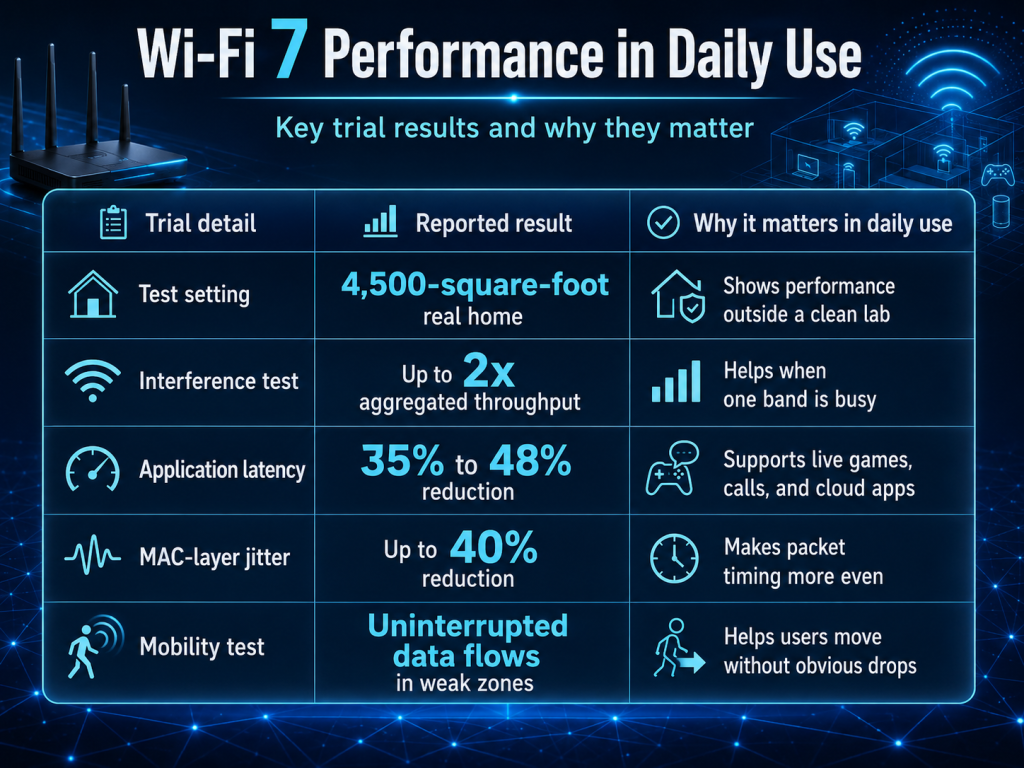
Original visual material, specifically created for this article.
A single wireless link can be fast, but it is also exposed. If that link gets crowded or weak, the session depends on how quickly the system recovers. MLO gives the device another route within the same local network.
On older setups, these activities can compete in ways users feel as short freezes or delayed responses. With Wi-Fi 7, the network has more tools to spread traffic and keep sensitive sessions moving.
Adoption is now strong enough to matter
The shift is also visible in enterprise spending. IDC reported that the worldwide enterprise WLAN market reached $2.9 billion in the fourth quarter of 2025, up 13.9% year over year. Wi-Fi 7 accounted for 39.7% of dependent access point revenue in that quarter, compared with 10.25% a year earlier. IDC analyst Brandon Butler said, “Enterprise WLAN is entering a new phase where it’s no longer just about connectivity, it’s about enabling AI-driven and digital business operations.”
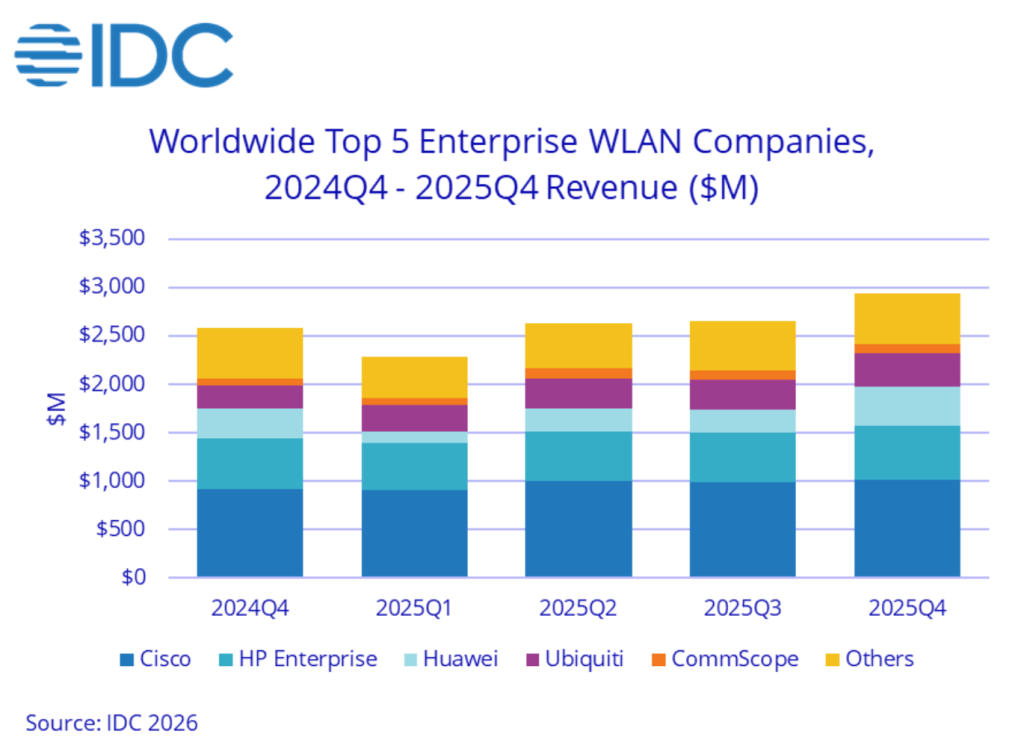
This IDC chart helps show that Wi-Fi 7 is becoming a normal part of network spending, not just a special upgrade. Enterprise WLAN revenue kept growing through 2025 and reached its strongest point in the final quarter of the year.
That is important for consumers as well, because enterprise adoption often speeds up better hardware, better chipsets, and wider support across laptops and phones. As Wi-Fi 7 spreads, MLO becomes less of a premium feature and more of a normal part of network design.
The practical limit is still compatibility. MLO needs support on both sides of the connection. A Wi-Fi 7 access point alone is not enough if the phone or laptop cannot use the feature. The backhaul also matters. A weak broadband line will not become strong because the local Wi-Fi is newer. But when the full chain is ready, Wi-Fi 7 can reduce the local wireless problems that users often blame on the internet as a whole.