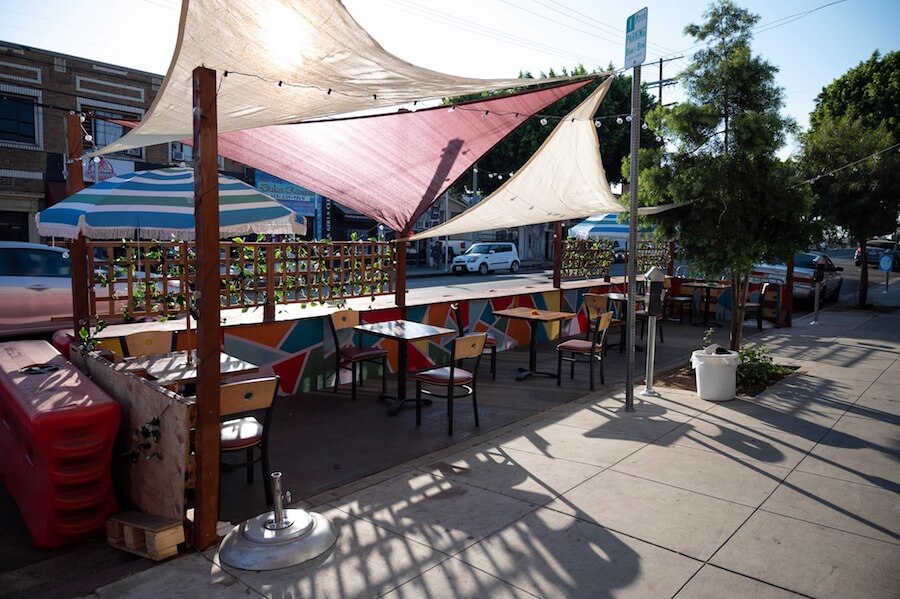
Proposal aimed at cracking down on Al Fresco violations fails at Venice Neighborhood Council amid resident-business tensions.
By Zach Armstrong
A proposed task force aimed at bolstering enforcement against businesses violating a COVID-19-era outdoor dining measure failed to pass the Venice Neighborhood Council last month.
The interagency task force, put forward by Venice Neighborhood Council President David Feige, was designed to investigate and enforce violations of the Al Fresco Dining Ordinance, a measure originally intended to aid businesses during the pandemic by allowing outdoor dining and suspending some zoning regulations. Years later, with restaurant owners crediting the ordinance with their survival and requesting more time to apply for the permanent Al Fresco program, the measure has been extended twice. Expanded patio spaces and sidewalk seating resulting from the ordinance have remained fixtures across Los Angeles’ dining landscape.
But some residents claim businesses are violating conditions of the ordinance, creating nuisances for nearby property owners who have few effective ways to report violations.
Under the ordinance, Al Fresco dining operators located next to residential zones must close by 10:30 p.m. Sundays through Thursdays and 11 p.m. Fridays and Saturdays, among other rules regulating excessive noise. According to the task force proposal, more than 100 complaints have been lodged against Al Fresco dining operators in Venice since the ordinance was adopted. Enforcement from local agencies has been inert, according to the proposal, due to complaints being redirected elsewhere or cumbersome reporting processes.
The task force, consisting of designees from several Los Angeles agencies, including the Beverage and Entertainment Streamlining Unit and the Department of Building and Safety, would’ve received calls concerning Al Fresco violations through an “Al Fresco Dining hotline.” Public exposure would’ve been another function. Data from complaints against Al Fresco violators would’ve been collected for a “publicly discoverable log,” which lists the names and addresses of businesses, along with the nature of complaints against them. In addition, a monthly list would’ve named businesses that received multiple violations.
“Compiling centralized data about the impact of Al Fresco Dining on neighbors and residents will go a long way toward balancing the scales. Due to a lack of complaint and enforcement options, operators are currently allowed to ignore the rules with impunity,” the proposal reads. “Collecting comprehensive complaint information will also allow the kind of targeted and thoughtful enforcement that can help curb the most egregious offenders.”
Although Venice’s Land Use & Planning Committee previously supported the proposed agency unanimously, the motion failed to pass the VNC last month by a 3-9-2 vote. According to VNC member Clark Brown, the decision was largely made so that LUPC could consider how the task force can accommodate Al Fresco establishments.
No alternative proposal is in the works.
“Karen” Accusations
The vote came weeks after Feige was caught in an online controversy over alleged efforts to take Al Fresco violations into his own hands.
Last month, numerous “WANTED” posters depicting Feige as the “Venice Karen” popped up across the Westside. “Who builds a multi-million dollar house right behind Hinanos and then calls the police 30 times in one day to complain about the noise?” the posters read.
In an interview with the California Post last month, Feige said the point of the posters was to “harass and intimidate” him, going on to say the claims are “complete lies pushed by a few bars that think they’re allowed to disrespect their neighbors by prioritizing their own profit over respecting their community.”
Hinano Cafe cooled tensions shortly after they started, stating on Instagram, “Let’s set the record straight,” and writing that Feige is not an enemy, but a “friend of Hinano Cafe and the businesses of Washington Square.”
Enforcement Concerns
As pandemic-era dining changes endure, some business owners say looming problems have included confusion over what is allowed by different permits and excessive reports of noncompliance.
The Brig owner David Paris describes the Al Fresco ordinance as a “life saver” for him and many others. Amid the pandemic, The Brig’s parking lot was converted into an outdoor dining patio that operates under a temporary Al Fresco permit. The bar, while also undergoing an extensive remodel of its patio, is now in the process of applying for a Coastal Development Permit to keep it permanent.
Paris says his establishment has been subject to numerous false or exaggerated noise and nuisance complaints in the past. Those complaints were a driving factor behind the VNC’s Land Use and Planning Committee decision in March to recommend denial of a coastal development permit for The Brig.
Paris welcomes stronger enforcement of the ordinance, but warns of problems if it’s done without rigor.
“If [the task force] is used to count how many complaints are made without regard to how valid the complaints are, that’s not helpful and it would be meaningless,” said Paris. “If the task force takes everything that neighbors say as automatic without investigation, then that’s a problem. It depends how the task force operates.”